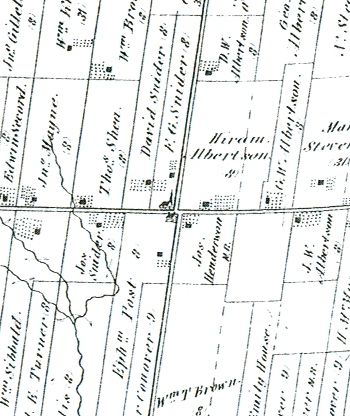
In the early nineteenth century settlers made their way along what to what is today the crossroads of Ninth Line and Burnhamthorpe Road West. The landscape was largely forested, and newly arriving settlers had the task set upon them to clear back the forests, build roads, and lay the foundations for prosperous farms. The story is not unlike other communities, and so began the hamlet known that was once known as Snider’s Corners.
The small crossroads hamlet of Snider’s Corners was named in honor of one of its earliest residents, David Snider. The hamlet was originally part of Trafalgar Township in Halton County. The western boarder of Mississauga was extended to Ninth Line in 1974 and now encompasses part of what was the small community of Snider’s Corners. Despite the fact that the hamlet only ever had a church and schoolhouse, it was became well known as a social centre for surrounding farm families.
David Snider, son of Michael Snider, was born in America in 1784, most likely in the state of Pennsylvania. David Snider’s ancestors, who originated in Germany, moved first to Maryland, where their name was recorded as Schneider. Michael Snider and his wife Catherine moved on to Canada in 1802, and obtained 200-acre land plot. He settled west of what is known today as Winston Churchill Blvd in 1809. David Snider followed suit, moving to Canada with his wife, Eliza Marlatt, likely together with her family, settling in Trafalgar Township in 1819. The Sniders became quickly renowned for their fine horses. David Snider was a farmer until his passing in 1862 at age seventy-nine. He is buried at St. Peter’s Anglican Church Cemetery in Erindale.
Joseph Marlatt Snider, son of David Snider, carried the mail to and from Postville (Trafalgar) for Snider’s Corners; a job he inherited from his father. Later he was appointed as Postmaster for Snider’s Corners. He also worked as a tavern inspector, assessor and tax collector.
On the corner of the Snider farm was the Wesleyan Church, built in 1839. Wesleyan was a Congregational Church, until it was closed and reopened in 1870 as a Methodist institution. The church did not have its own cemetery, instead using the one at Munn’s Corners. In 1886 a new church building replaced the old one. Herbert Albertson, born in 1865, was the leader of the church choir. Fred Forster had been the church organist for forty-two years and in 1949 three of his daughters donated a pulpit and pulpit bible to the church. Their donation went to Munn’s Church, when the two churches amalgamated in 1964. The Wesleyan Church building was sold for $2000 on October 15, 1964, and today it no longer exists.
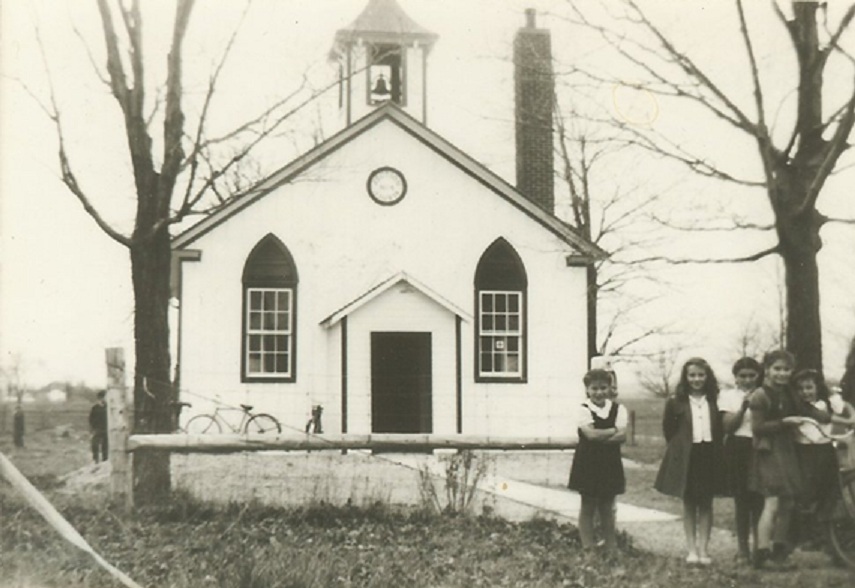
Across the road from Wesleyan Church, when Snider’s Corners was at its height around 1890, was the one-room schoolhouse, S.S. #4 Trafalgar. According to Jessie Forster (McAdam), the schoolhouse was of a board and batten exterior that was painted white. When the weather was nice the students would eat lunch outside under the trees and play baseball with a piece of lumber and ball, sometimes asking the teacher to join in their games. On May 16, 1866 Joseph M. Snider wrote the following in the visitor’s book about his visit to the school on that same day: “I have had the pleasure of visiting the school and am much pleased in the way and manner which the scholars has [sic] went through there [sic] lessons and answering the questions.” The school building is now a residence, located on Burnhamthorpe Road.
Jessie Forster (McAdam), who was born in 1909 and lived in Snider’s Corners until she was thirteen, also tells of the many social events the school and church would put on, sometimes to raise money needed for the community. The events would even encourage friendly competition between other schools and churches. They held picnics, box lunches, box socials, fowl suppers, festivals, concerts and plays, among other things.
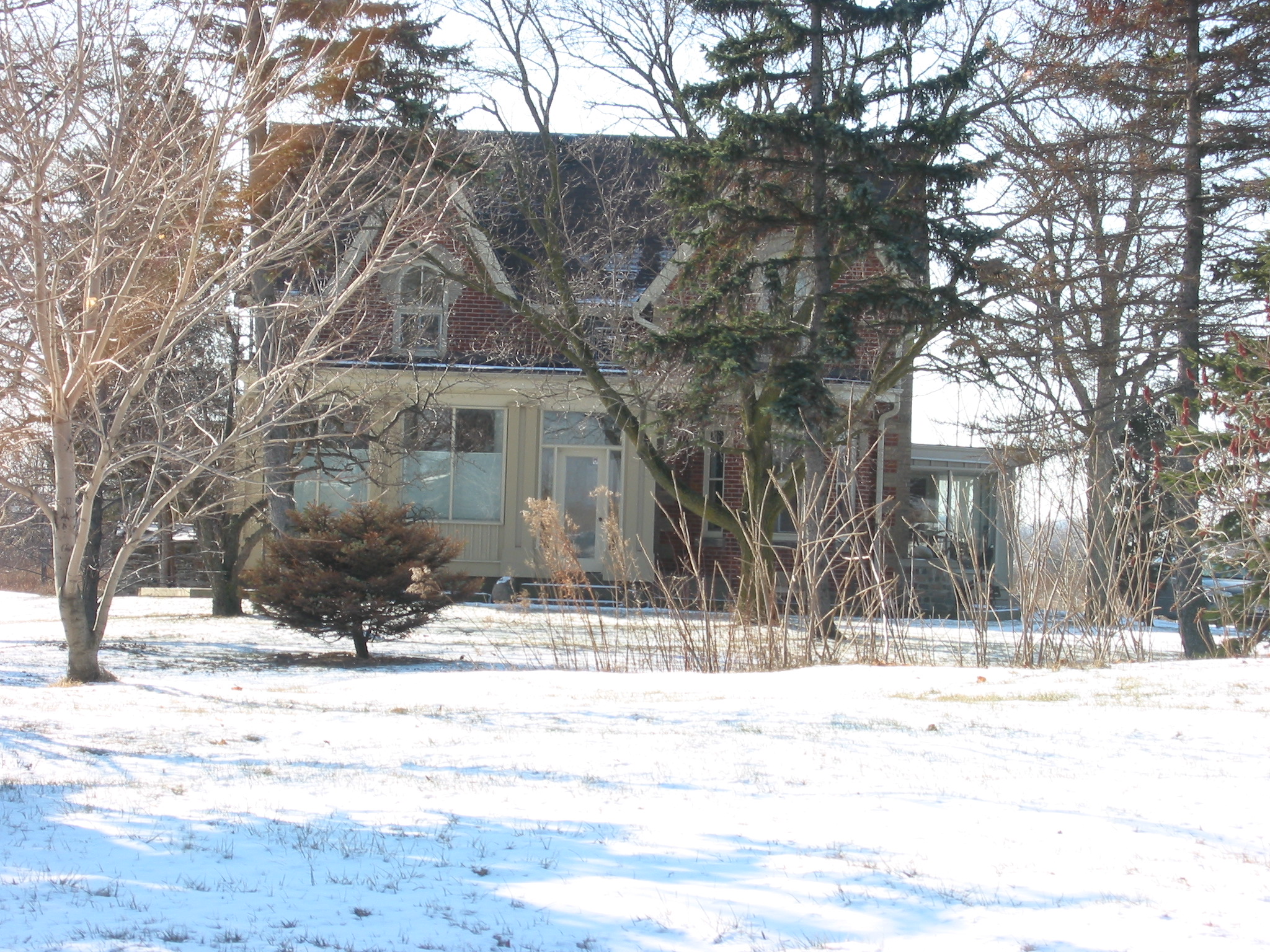
One of the last surviving Snider’s Corners landmarks in Mississauga was a red-brick Victorian farmhouse with yellow trim. The house was built in the 1870s for David Ward Albertson. Frederick A. Forster then bought the house sometime before his marriage to Sarah Jane Walker in 1883. The building, however, was demolished in the early 1990s by the Department of Transport to make room for expanding the 403 highway.
The Albertsons were another prominent family at Snider’s Corners. William Albertson was born in 1793 in New Jersey and came to the Trafalgar Township with his family in 1811, settling at what became Snider’s Corners prior to 1823. He fought against the Americans in the War of 1812. At the battle of Queenston Heights, William Albertson sustained a head injury and was a few feet away from General Sir Isaac Brock when the famous leader was wounded. Some even say that he helped to carry the injured General from the battlefield. In 1837 he helped to drive out the rebel forces of William Lyon Mackenzie from Navy Island. He died at age eighty-three in 1877, and was buried at the Cosmopolitan Cemetery, in Erindale.
Another early family in the area was the Forster family. The Forster came from Northumberland County, England. Newton Luther Forster, the father of Jessie Forster McAdam (who wrote about life at Snider’s Corners), sold wine for a short time, mostly to his fellow neighbours, much to their wives’ chagrin. He also had a twenty-five acre orchard, where he and his family grew a variety of apples for export. Sometime in the early twentieth century, Newton L. Forster bought an additional farm, and decided he could improve the worth of his investment by adding a barn to it. Once the floors and other necessities were in place, the whole community came to help with a barn raising. The men put together the frame and rafters, while the women and children prepared for a picnic, and afterwards, dancing.
Phone service was first made available to the residents of Snider’s Corners in 1912, a common line shared amongst twenty families. Electricity did not become available until the 1930s. Despite the relatively slow progression of Snider’s Corners into the twentieth century, modernization began to take its toll. Like many other small farming communities, most physical evidence of the village has been lost. No buildings remain today on the Mississauga side of what was Snider’s Corners. However, on the Oakville side, a few still survive: the old schoolhouse, as well as Ephraim Post’s house on Ninth Line and James Snider’s house, of which only the original door frame remains. Most of the buildings and farms may be gone, but the memories of the families that lived at Snider’s Corners, those of the Albertson, Brown, Ellis, Forster, Marlatt, Moffitt, O’Hara, Phenix, Post, Secord, Shea, and Snider families, among many others, continues to endure.