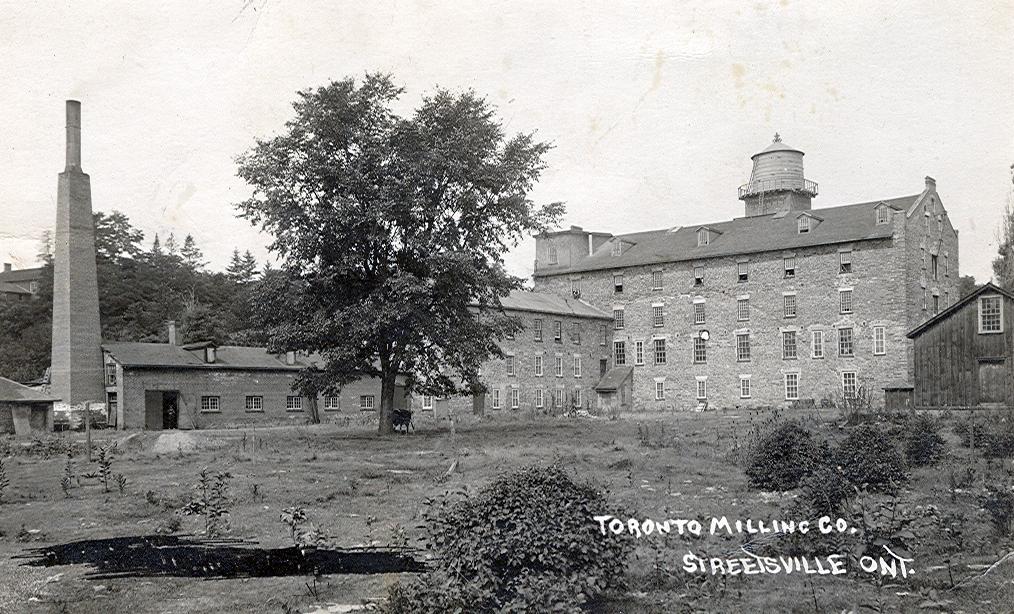
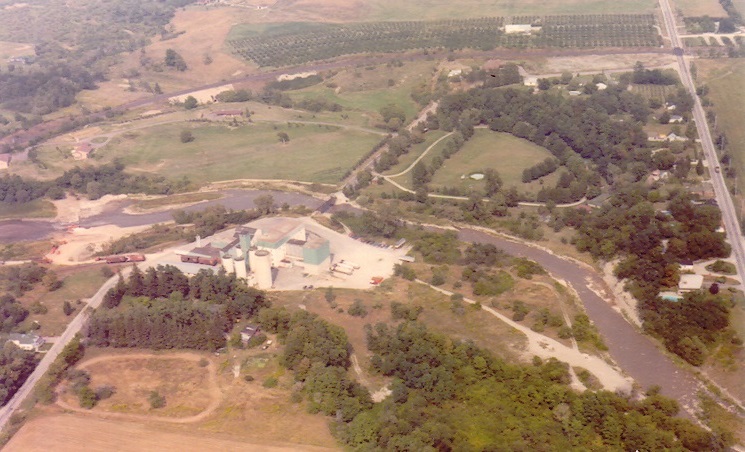
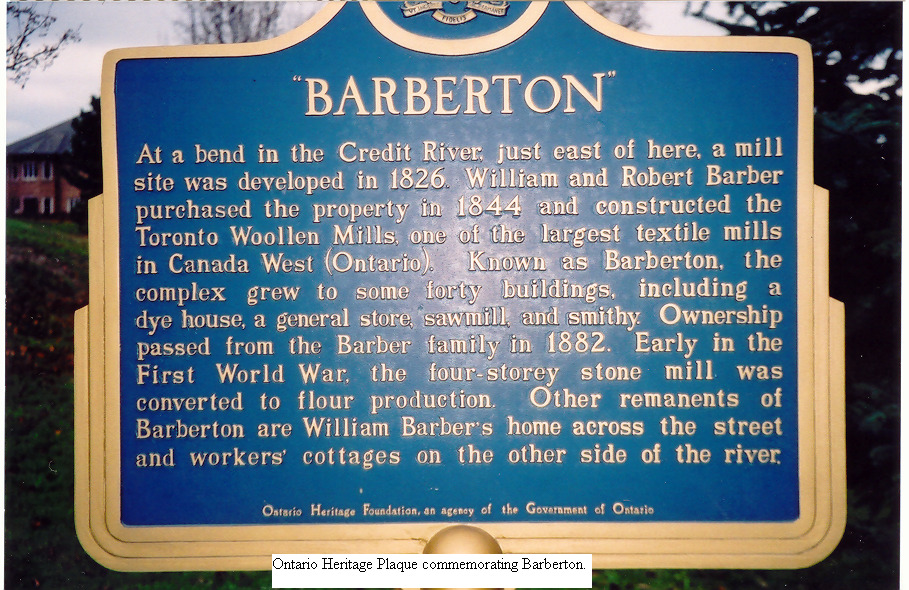
Have you ever noticed the industrial complex along the Credit River, visible just north of the Eglinton Avenue bridge over the river? Have you ever walked along this part of the Culham Trail, wondering at the story of this buzzing industrial complex in the midst of the river valley? Have you ever wondered at the road name “Barbertown” or walked across the tiny one lane bridge, now solely reserved for walking? Our continuing effort to collect the stories of Mississauga’s “Lost Villages” brings us to Barberton (also known as Creditvale), to the former mill complex of the Barber brothers, and a look at some of the people who called this mill-village home.
The lazy course of the Credit River today belies its importance to the early development of Peel County. The establishment of mills, particularly saw and grist mills, often marked the beginning of a community and provided the impetus for growth. Mills fulfilled a practical need in the life of early settlers as places to grind grain, cut wood, or weave cloth. By 1851, approximately 60 mills were operating along the Credit River and by 1859, 10 of these were woollen or textile mills.
One of the most significant of these textile manufacturers was the Barber brothers’ mill near Streetsville. The Barber brothers, who also owned a large mill in Georgetown, expanded their operation in 1843 when they purchased William Comfort’s mill-site and farm. William Comfort had purchased this site on the north edge of Lot 1 Concession 4, just south of Streetsville, in 1826. He had a grist mill in operation by 1827. William Comfort, a loyal supporter of William Lyon Mackenzie during the Rebellion of 1837, is believed to have sheltered the rebel leader at his home on the second night following the failed uprising. Comfort was jailed, and later sold his interest in the property to the Barber brothers.
In 1852, the Barbers built a large four-storey stone woollen mill, which burned in 1861. Three months later the mill was rebuilt and back into production. Due to the early success of the mill, the site continued to expand and by 1865 included several additional buildings. The mill complex, known as the Toronto Woollen Mills, produced 1000 yards of cloth daily and employed 100 people. By 1870, the mill was the fourth largest textile mill in Ontario. It is the stone mill built in 1861 which survives underneath the modern layer of stucco and siding.
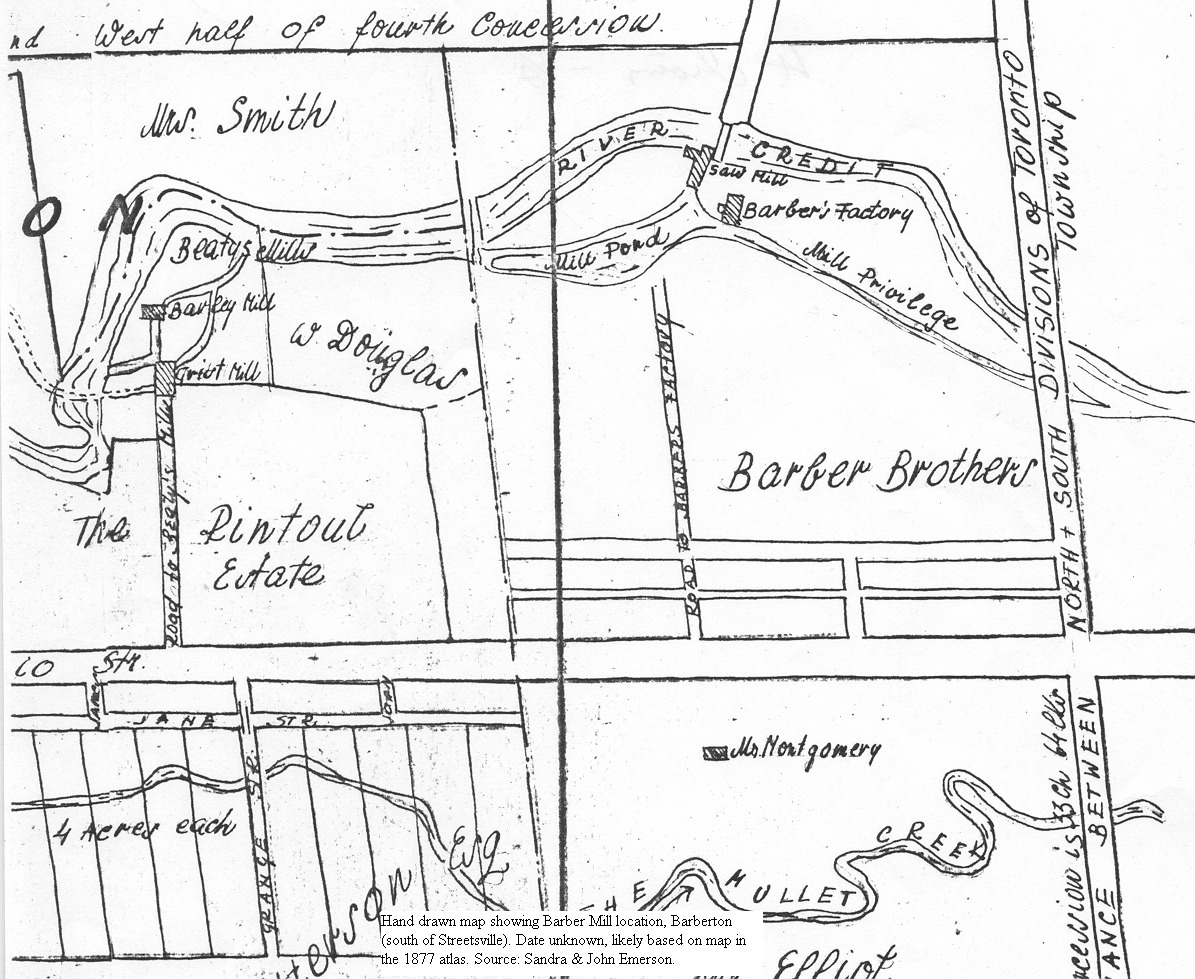
Barberton Map
The small community that began to develop around the mill site became dubbed “Barberton”. Barberton never gained village status on its own, but it grew steadily. The Barbers built 43 buildings for mill workers and their families. Some of the workers came from Scotland as skilled weavers (John Rutledge was one). Most of the workers lived in close proximity to the mill. Entire families often relied on the mill for their income and livelihood. In many cases, members of an entire family were employed in the mill. Such was the case with the Henry Rundle family. Henry was employed for a time as a servant in the Barber household, while son James was employed as a millwright, Thomas as a weaver, and daughters Delia and Anna as spinners. In addition to the families who worked in the mill, Barney McCusker operated the blacksmith shop nearby and Augustus Redding ran a tailor shop, employing fifteen seamstresses. J.G. Owens operated the two-storey general store (presently the ADM Milling company office). The chief teamster, Henry Hetherington, made two trips a day to Port Credit with finished goods and returned with raw materials. Moses and Mary Strong ran a boarding house where weekly dances were held. Barberton also had a recreation area and a cricket field.
One interesting story about life for the workers and working conditions at the mill is the introduction of a tea break. One of their employees, Hannah Clegg, took her teapot to work one morning, and made tea at 10 a.m., having already worked from 6:30 a.m. When the Barbers protested, all the women went on strike. The Barbers gave in, and from then on, a tea break at 10 a.m. became a ritual for all employees at the mill.
As for the owners themselves, William and Robert Barber, together with Bennet Franklin, their partner and brother-in-law, had large homes built for them. The brothers were also very active in local economic, religious and political circles. William and Robert operated the woollen mill while Bennet managed the saw mill. As the fortunes of the Barbers’ declined, the small community that had grown around the mill became deserted, leaving only the ghosts of the once-busy mill village behind. William’s home, built circa 1862, remains on the corner of Mississauga Road and Barbertown Road as the Old Barber House Restaurant. Robert and Bennet’s houses on Barbertown Road are now gone as are most of the original 43 buildings. Only three workers’ houses survive. The old mill bridge (circa 1898), Barbertown Road, and a quiet recreation area are but a reflection of this once vibrant little community, and the mill’s importance to early workers and their families. For more information on the Barber brothers and their enterprise, we invite you to take a walk along the Culham Trail and visit the interpretive plaques highlighting more of the interesting story of the mill-village of Barberton.
With the changing times, this site remains remarkable in its continuing ability to provide service and employment. After many successive owners, changes in technology and changes in product, the mill-site remains the true legacy: a site well chosen to suit the changing needs of the people relying upon it. The mill still stands as a functioning element of modern industry. It would, perhaps, make the Barber brothers proud.