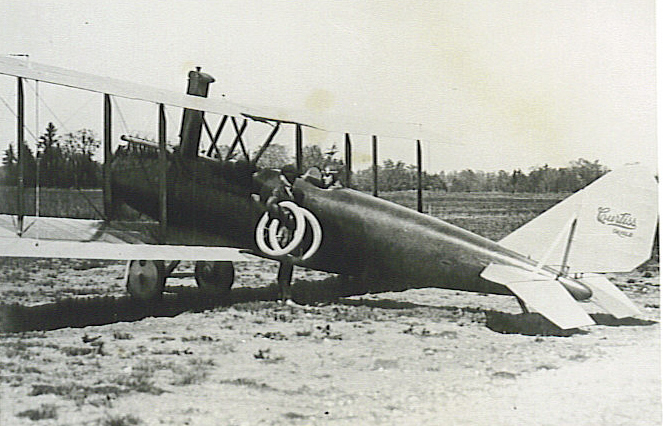
Curtiss Aerodrome Plane, c. 1915
Between 1915 and 1919, Canada’s first aerodrome was operated in Lakeview (now part of Mississauga). In May 1915, Curtiss Aeroplanes and Motors Ltd. established a flying school in Lakeview. The school, and nearby Curtiss aircraft factory, were managed by J.A.D. McCurdy, Canada’s first aviator. Students at the school piloted Curtiss Model F “Flying Boats” and the Curtiss JN-3 “Jenny” biplane. After graduation, pilots went to England for further training and would either join the Royal Flying Corps or the Royal Naval Air Service. Between 1915-1916, the school produced 129 graduates before closing on December 15th, 1916. In January 1917, the Long Branch Aerodrome became home to two squadrons, X and Y, of the Long Branch Cadet Wing with the newly formed Royal Flying Corps Canada. At its height, it could accommodate up to 1200 cadets before closing in 1919.
In 1936 the Government of Canada was looking for a site for the Trans-Canada Air Lines and purchased over 1,400 acres of farmland in Malton to build the airport with construction planned for 1937. The Malton Airport, the forerunner of today’s Pearson International Airport, first opened in 1939. The new Malton Airport had only one terminal, but due to the increased interest in flights from Malton Airport, additional terminals were added and the airport continued to grow.
During the Second World War the operations of the Malton Airport were halted and it was used as a flying school from 1940 to 1945. Malton was home to several wartime industries during the Second World War, including Victory Aircraft and the British Commonwealth Air Training program. A subdivision, known as Victory Village, was built beginning in 1942 for workers and veteran’s housing.
After the war, Victory Aircraft merged with A.V. Roe Canada, who developed the CF-100 “Canuck” and CF-105 “Avro Arrow” all-weather jet interceptors. The aircraft was designed, built and flown in Malton (now within the City of Mississauga) between 1957 and 1959. The plane was hailed as being ahead of its time, and became a source of National pride in Canada. The cancellation and subsequent destruction of the Arrow, and of its component parts left many thousands of people out of work on a day which became known as “Black Friday”.
After 1946 and the end of the Second World War, the Malton airport continued to grow with flights expanding exponentially and a third terminal was built. In November of 1958 the Malton Airport was renamed the Toronto International Airport and then in 1984 it was renamed the Lester B. Pearson International Airport and is referred to today as the Toronto Pearson Airport. Today Toronto Pearson Airport is the one of the largest and busiest airports in Canada, one of the busiest airports around the world, and serves over 40,000,000 passengers a year.
Read more:
A Mississauga Legend by Eric Gibson
Arrow and Sputnik by Eric Gibson
First Flight of the AVRO Arrow by Eric Gibson
A Forgotten Anniversary by Matthew Wilkinson
Flying into History – Firsts of the AVRO Arrow by Matthew Wilkinson
Black Friday and the Cancellation of the AVRO Arrow by Matthew Wilkinson
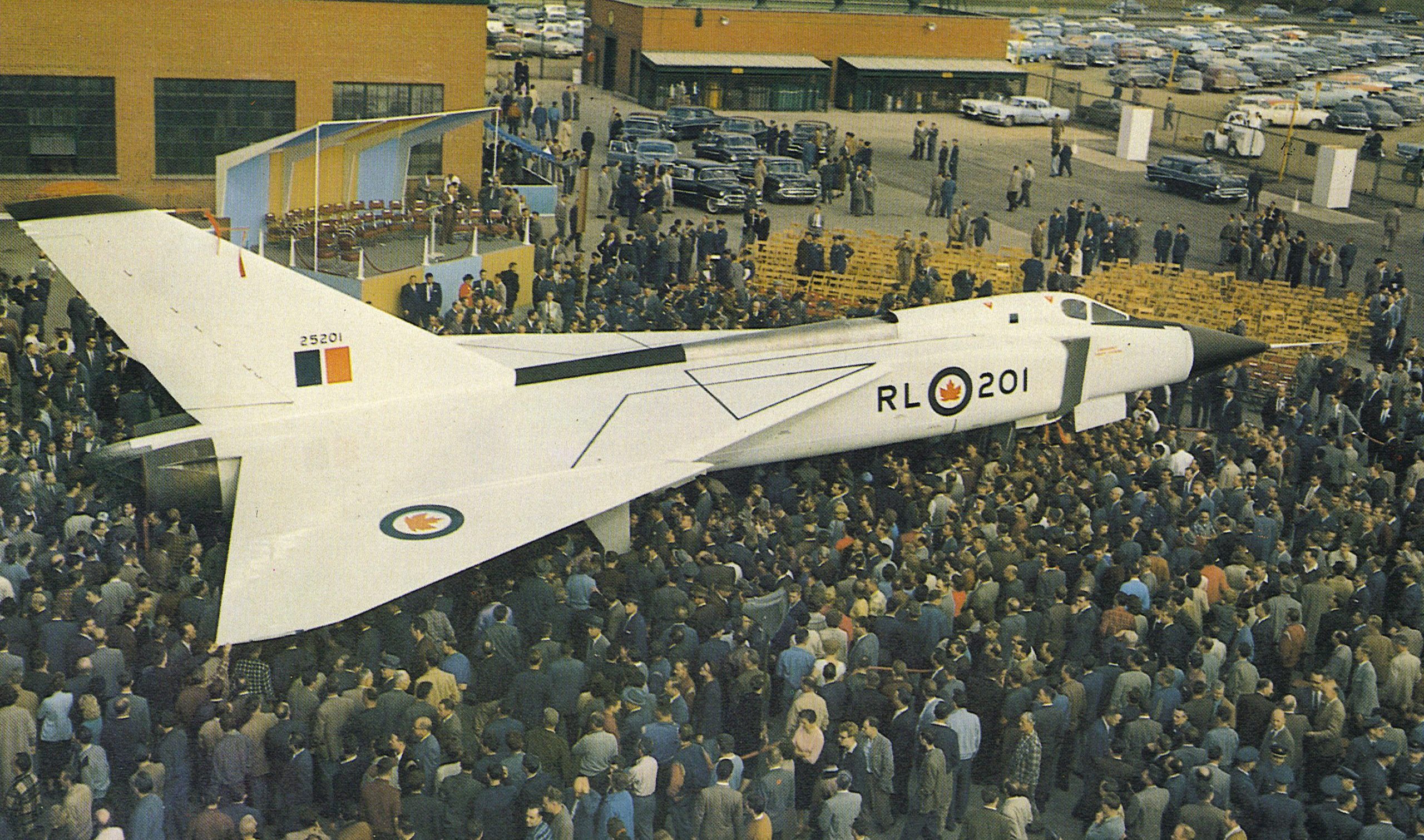
Avro Arrow unveiling, 1957