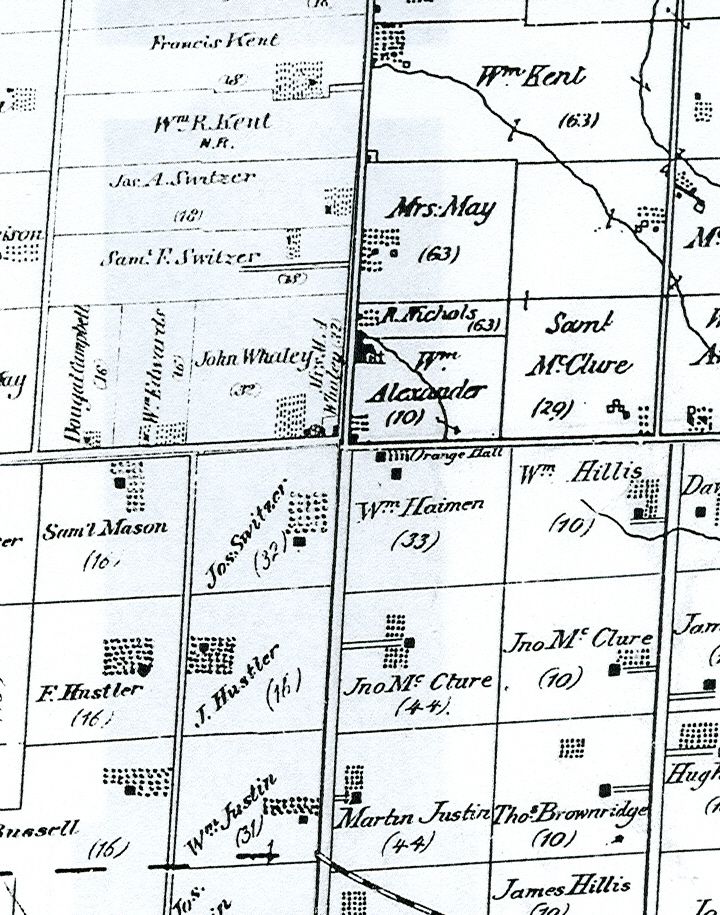
Picture this: it is the mid-nineteenth century and you are travelling north on Town Line – modern Winston Churchill Boulevard. The road is made out of wooden planks, worn smooth by the continuous travels of horse-drawn wagons and stagecoaches. On either side of the road there is nothing but farmland and trees as far as the eye can see. The occasional farmhouse dots the landscape, perhaps it is made of logs cleared from when Toronto Township – present-day Mississauga – was nothing but bush. Eventually you come to a crossroads, and a toll gate comes into view. You know you have reached the small community of Whaley’s Corners, located at the present day intersection of Winston Churchill Boulevard and Steeles Avenue.
The history of Whaley’s Corners goes back to the beginning of the nineteenth century, before too many early settlers had arrived to start new lives in Canada. According to William Perkins Bull – the famed Peel historian – in the early 1800s, a wealthy American syndicate purchased land at Whaley’s Corners in order to set up a small colony of American citizens. The project was quickly abandoned however, possibly due to losses suffered in the War of 1812. This land was sold off to private citizens, including many United Empire Loyalist settlers, particularly those who had originated from the North of Ireland. One of these settlers was William Whaley, after whom the crossroads community came to be named.
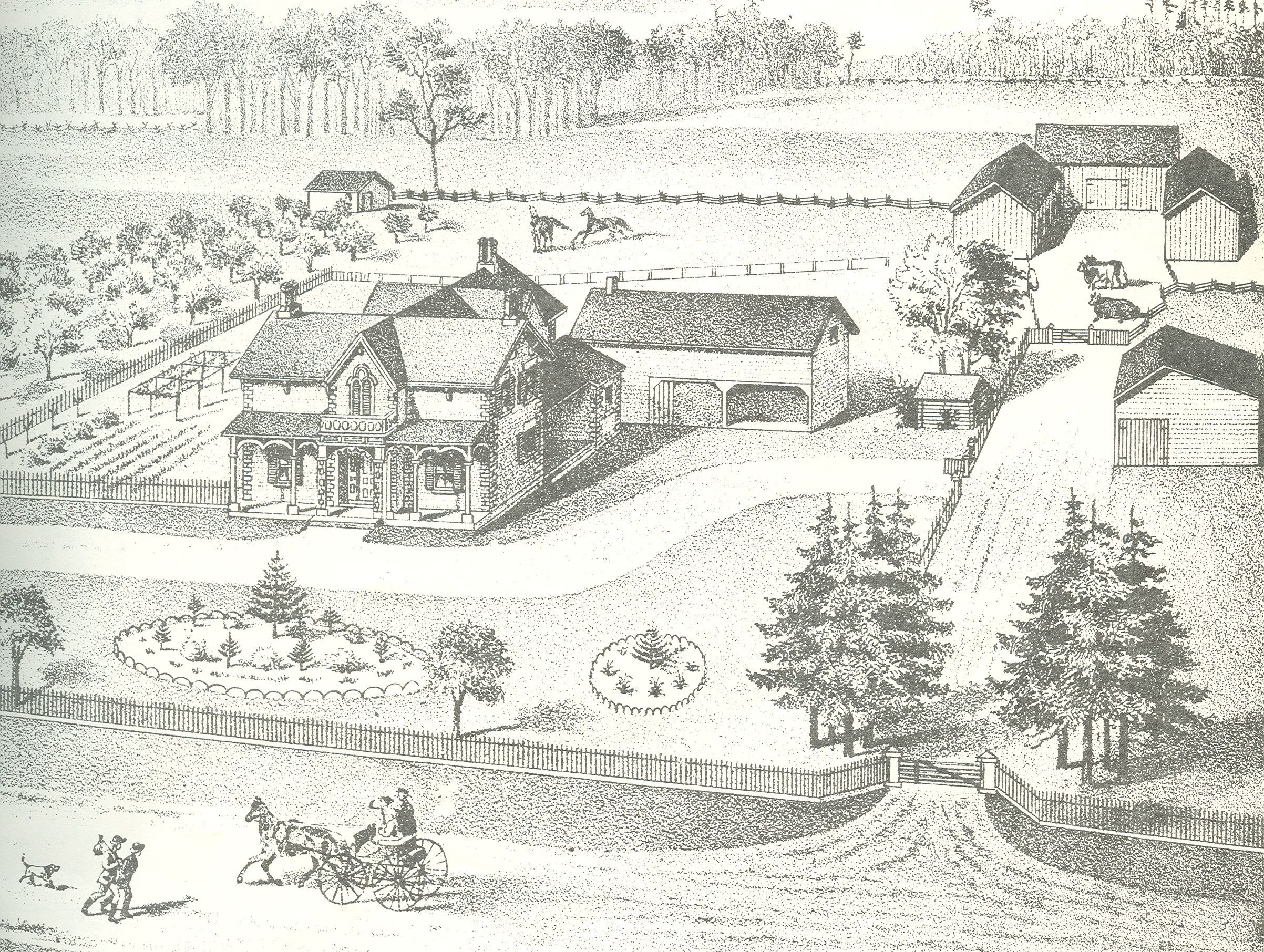
The Whaley family originally hailed from England; they fled to County Armagh, Ireland, during the Cromwell regime. William Whaley and his family emigrated from Belfast, Ireland to the state of Delaware in the United States, before taking up land at Whaley’s Corners in 1819. By April of 1822, William had cleared 5 acres of his 100 acre property, fenced off his land and built an 18×20 foot house. He had 200 acres in Esquesing Township in Halton County and 100 acres in Toronto Township. He would become integral to the commercial and physical growth of Whaley’s Corners.
William Whaley and his first wife had seven children: George, David, John, Sarah, Emma, Eliza and Agnes. There are no records of Whaley’s first wife; however, there is record that William Whaley remarried Mary Ann McCracken, a widow who lived from 1810 to 1890. One resident recalled that when his children were growing up William Whaley used to ride along the road in his gig – a two wheeled carriage pulled by a single horse – wearing a silk hat and acting like a refined gentleman, like his father before him. William Whaley died in May of 1869, and was interred at St. Stephens Anglican Church in Hornby. Mary Ann McCracken Whaley received the house, tavern and half an acre of land upon his death, located on the Esquesing Township side of Winston Churchill.
William Whaley’s son, John Whaley, built his house at Whaley’s Corners out of logs he cut down from the bush. The first crop he grew on his farm was likely corn. He would take his produce to Toronto by wagon from Whaley’s Corners. John Whaley was married to Ann Wiggins, who was born in Ireland. The couple had five children: William, Jack (also recorded as John A.), Robert James, Hannah E. (also recorded as Harriet C.), and Annie M. Whaley. Hannah E. Whaley, who married Alfred J. Bell, used to have an old spinning wheel when she was living with her parents. Her father and brothers would take the sheep down to the water’s edge near Churchville, 20 to 25 at a time, to wet and shear them. There are stories of when John Whaley would be coming home from another farm and wolves would be chasing after him, he would keep the wolves away with a torch lit from a flint.
Robert James Whaley, son of John Whaley, also lived at Whaley’s Corners, along with his wife Florence Johnston. By the early 1900s, Robert Whaley’s farm was the only thing left to indicate that Whaley’s Corners had ever existed. In August of 1933, while driving his buggy home from his son Gordon Whaley’s house, Robert Whaley was hit by a westbound CPR train at the Hornby railway crossing and killed. He was buried in the Mount Zion cemetery. Twenty years later in 1953, Gordon Whaley was killed in a truck accident near the McLaughlin farm. His wife Lena MacMillan Whaley worked for AVRO Canada in Malton and continued to work there until its close in 1959. She rented out the farm in 1969, before eventually moving to Brampton.
For many years Whaley’s Corners had a gossip column in the Streetsville Review. In the column were reports on many local happenings, including Alexander Kent’s barn raising on June 5th, 1894, in which a 60×30 foot barn was raised by the community. The column also included reports on Whaley’s Corners very own boys football team. The team was named the Victorias.
There was a plank road that ran down the Town Line, present-day Winston Churchill Boulevard – and it was said that a stagecoach used to travel down it. There was a toll gate on the plank road right at the corners. The toll gate was operated by William Alexander. He charged a ten cent toll, according to Mrs. Bell, daughter of John Whaley. William Alexander had a hut on the corners near the toll gate so no one could pass without his notice. He married Miss McCoy who, according to family tradition, had brought a set of dishes with a pink willow pattern with her from Ireland.
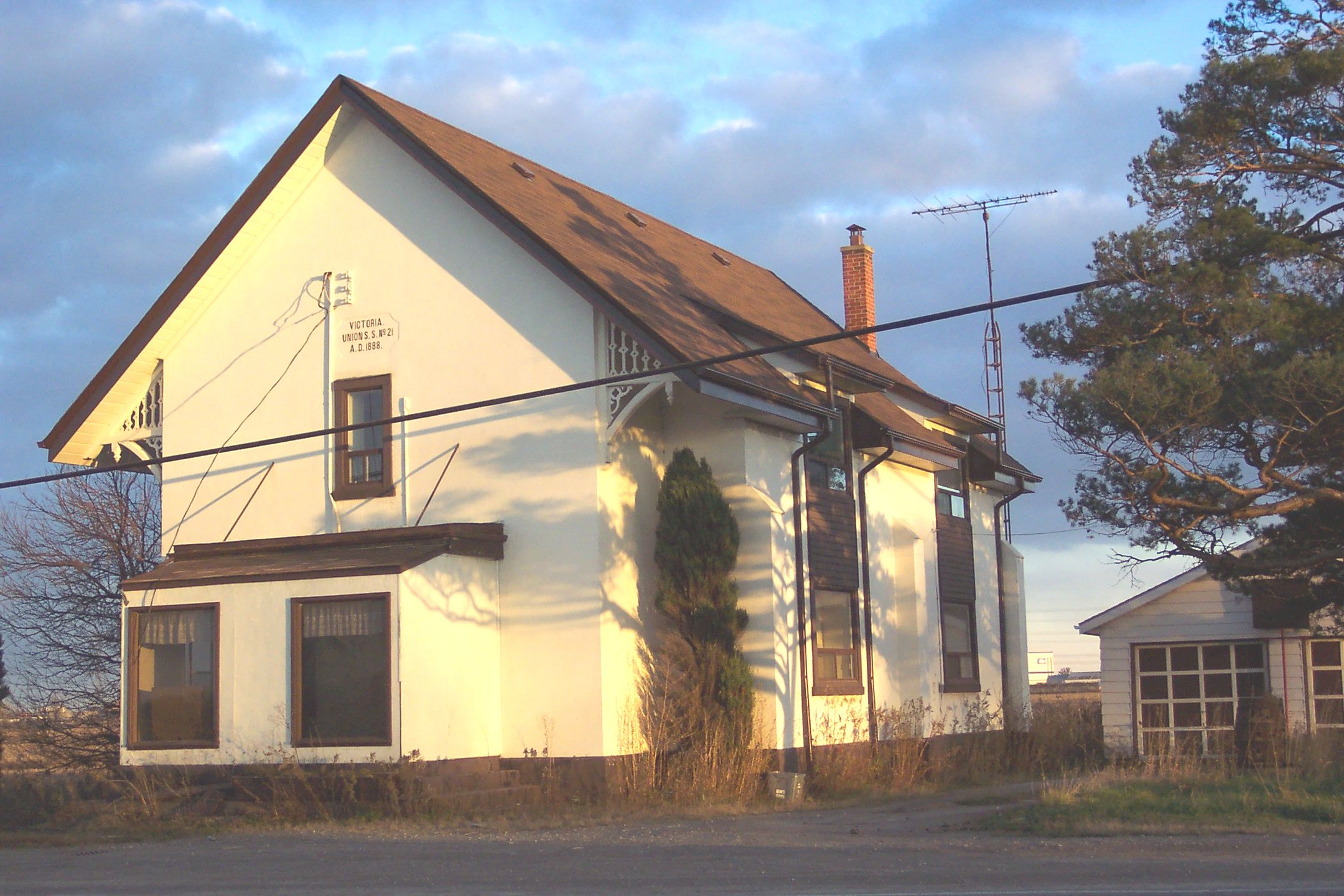
The school at Whaley’s Corners was a log schoolhouse built in 1832, located on John Whaley’s farm, near the west corner of Winston Churchill Boulevard and Steeles Avenue. The school was listed under the Chinguacousy County, present-day Brampton. By 1888 it was known as the Victoria Union School Section, S.S. 21. One of the early teachers at the school was a Miss Bollard, who lived in Toronto Township. Another teacher was a J. Black, who taught 32 students at the school in 1851. Before a school was established at the neighbouring village of Churchville, children from that community also attended the school at Whaley’s Corners. In 1888 a new school was built, and was located on the south side of Steeles Avenue and to the east of modern Winston Churchill Boulevard. The school was used until 1959, when it was closed and turned into a residence. In was torn down around 2003.
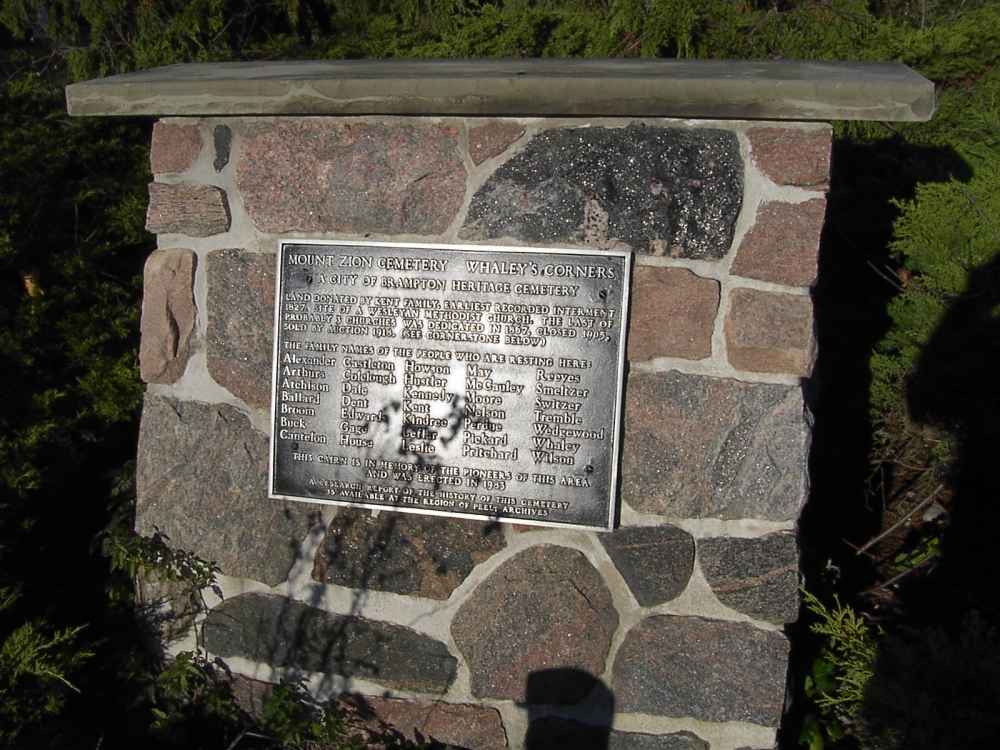
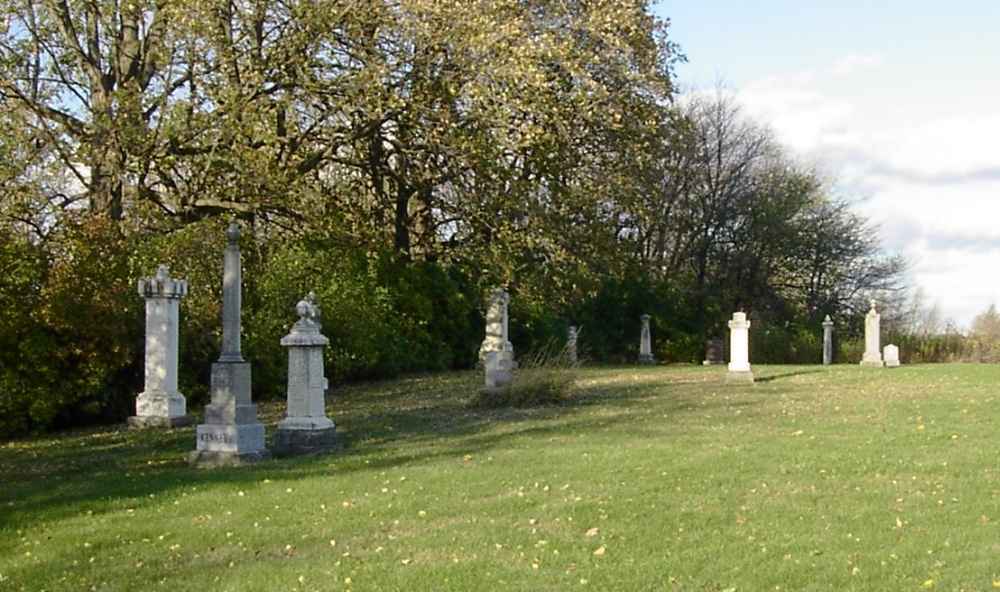
In 1827 land was purchased from the crown for the purpose of a cemetery at Whaley’s Corners. The first person to be interred in the new cemetery was Nicholas Kennedy. A short time later a frame structure was built on the burial ground for a community church. Reverend Heyland was the first minister. In 1867 a new log and frame church was built, and this building would come to be known as Mount Zion Methodist Church. This second church was dedicated on November 17, 1867. The church was at different points in time part of the Streetsville and Brampton circuits. James Gooderham, of Streetsville, a local preacher, gave sermons at Mount Zion. Inside the church there were tin candlesticks and candles, each about a foot long, to light the interior of the church. The congregation often held local events to raise money to support the church, however, as the years passed the church collections decreased considerably.
By 1905 the size of the congregation at Mount Zion had dwindled down significantly and the church was closed. In 1918 the cemetery board decided to auction off the church and cemetery, the auction took place on December 3, 1918. The church building was sold to Robert Whaley for $300 and the church’s driving shed was sold to Arthur May for $188. The pulpit was sold for $2.25 and the organ was sold to Mr. D. Cordingley for $2.00. The sum of the church and contents sold at the auction amounted to a total of $571.30. The cornerstone of the second church, dated 1867, was retained by the Whaley family. The old Church building was later sold, for a second time, by Robert Whaley to Jack Fraser Farms – also referred to as Jack Frazer Farms – of Huttonville, and it was turned into a driving shed. In 1980 and 1981, the Parks Department for the city of Brampton started a restoration program for the cemetery. In 1983 a cairn was erected, and the cornerstone from Mount Zion was laid at its base.
The Orange Hall at Whaley’s Corners was one of the oldest lodges in the area. Mrs. Bell recalled that the lodge was a plain farm building that had a door in the front and three windows on each side. The building was located on the Toronto Township side, or south side, of Steeles Avenue. The Loyal Orange lodge certificate was granted in 1835 to Andrew Grundy and it was registered as Orange Lodge L.O.L. No. 62. According to Perkins Bull, the Orange Lodge at Whaley’s was “home of those lusty Town Line Blazers who first taught the Roman Catholic and the Grits of Toronto Township that Orangemen could look after themselves.” There also used to be a band in the Orange Hall. There were a number of local residents associated with the Orange Lodge at Whaley’s Corners: Henry and James Arnott, John Cook, Adam Halliday, John T. and John S. Hanna, John A. and Joseph S. Mason, and John Rutledge. James Gooderham did electioneering in the Orange Hall when the railway was being built. William Menary was deputy master of the lodge in 1834. William Whaley was the first committee-man of the lodge and held the position of deputy master in 1837. Francis Birdsall, brother of Colonel William Birdsall, belonged to No. 62 and was Grand Committee-man in the 1850s. At one time James Orr was master and Henry Rutledge was master in 1902. John Whaley used to march in the July 12th day parade, though he was not an Orangemen himself, he wore the scarf of the order and “would not have given it up for anything.” The Orange Lodge ceased operation sometime in the early twentieth century and the lodge’s records have since disappeared. Mrs. Bell recalled also, that when the lodge was “finally sold to Alexander Kent about 1905, Joe Hillis, who liked his drop, received the sad news in a tavern, where he had evidently been trying to fortify himself. Hillis cried so bitterly that the bar-tender too wept in sympathy.” The hall was moved to the Kent property where it became a residence after the Kent farmhouse burned down.
There were a number of other very important aspects to the community of Whaley’s Corners. At one time a tavern was located at Whaley’s Corners, owned by William Whaley. It was known as Whaley’s Inn. When John Whaley became the proprietor of the hotel and tavern, balls were often held there. One of Hannah Whaley Bell’s aunts, probably a sister of John Whaley, would play the dulcimer to provide music at the balls. In October of 1848, William Whaley put an advertisement in the Streetsville Review: he advertised a farm and tavern for rent, with excellent stables and out-houses. The tavern was later taken over by Aaron Laidlaw and renamed the Royal Albert Inn. The blacksmith shop at Whaley’s Corners was also likely owned by William Whaley. Andrew McFarlane, Thomas Nicholl and Richard Howell all worked as blacksmiths there. Whaley’s Corners had an ashery as well, where soap was made from lye. There was no post office in Whaley’s Corners; the mail was delivered from nearby Churchville.
The community of Whaley’s Corners remained small throughout its existence, including up to the early nineteenth century when the community was practically no more. While it is difficult to determine exactly how close-knit the hamlet was, it is clear that the residents of Whaley’s Corners often came together in support of their community. Please help to preserve the history of those early residents, by remembering the names: Alexander, Arnott, Hillis, Kent, Mason, May, McClure, Switzer and Whaley, among others. Help to keep the spirit of Whaley’s Corners alive by sharing your memories and pictures.