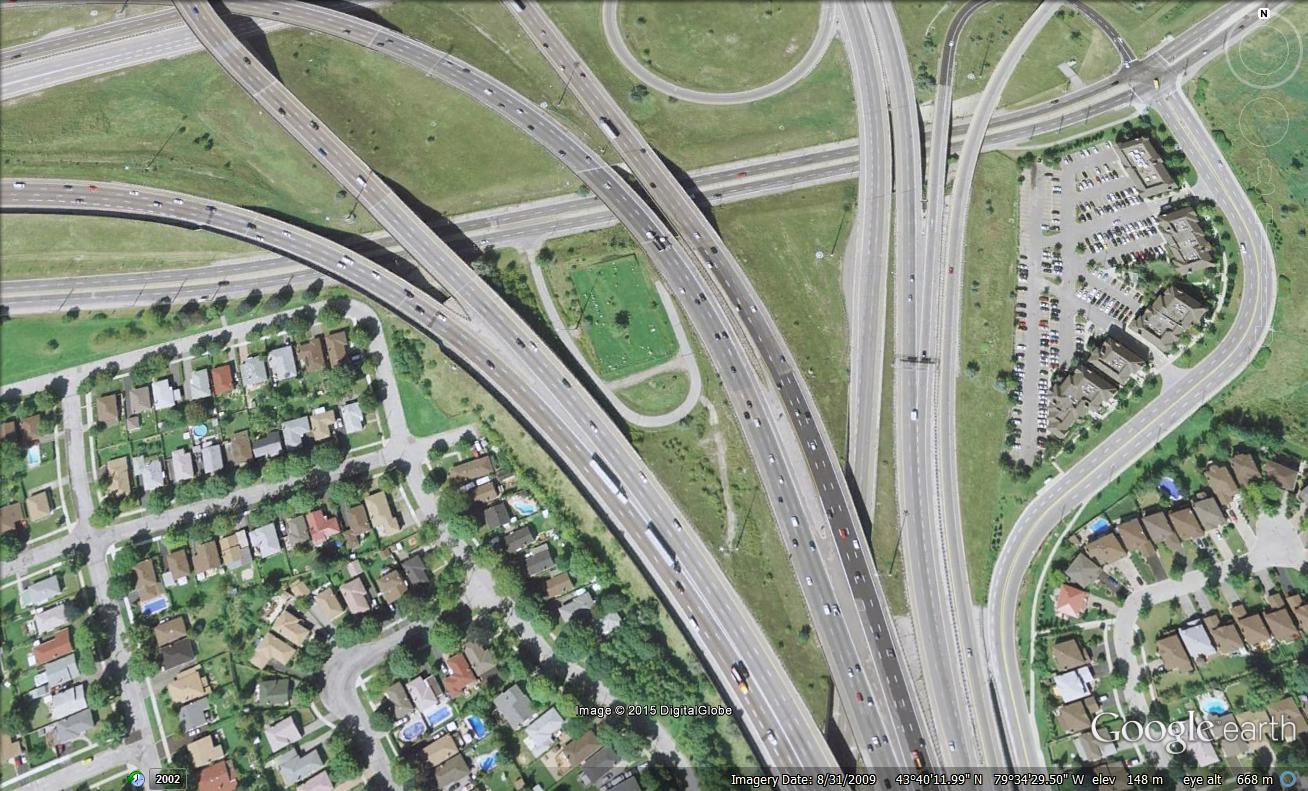
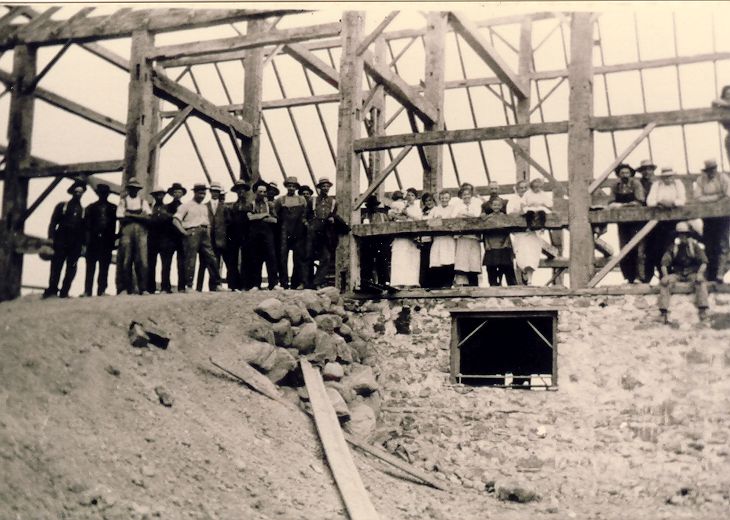
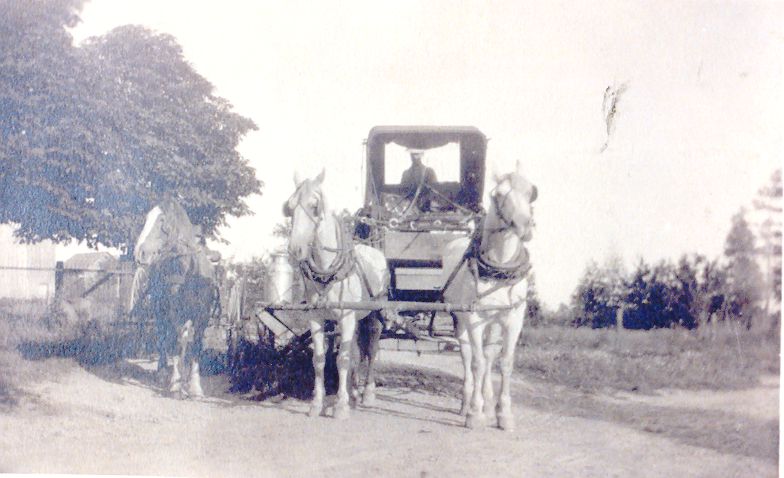
While traveling along to the intersection of Highway 401 and Highway 427, have you ever noticed the small cemetery lodged off to the side surrounded by onramps? This isolated pioneer cemetery is one of the few remnants left today of the village once known as Richview.
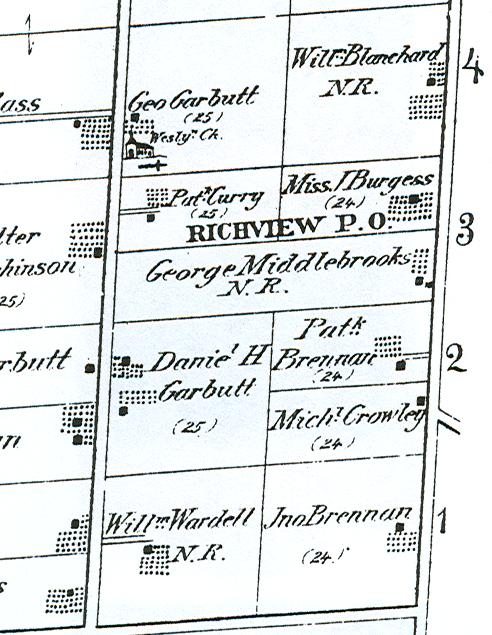
The village of Richview was a border village, located partly in Toronto Township, partly in Toronto Gore, with some residents living in York West. It was officially named Richview when the village post office opened February 6, 1852.
The first postmaster was John Davis, who worked from 1852 until he resigned in 1865. He was followed by Robert M. Burgess, who was postmaster from 1865 until the year of his death in 1876. Miss Jennie Burgess, postmistress from 1876 to resignation in 1886, succeeded Robert Burgess. The post office was moved at that time from Toronto Township to Etobicoke Township, to the southwest corner of concession 3, where David Watt took over as postmaster until 1906. Louis La Rose was the next postmaster from 1906 to 1911. The last postmaster was James Peacock who ran the post office from March 1911 to July 1911, when it finally closed. Prior to the post office, mailbags were dropped from passing trains and a local farmer delivered the mail.
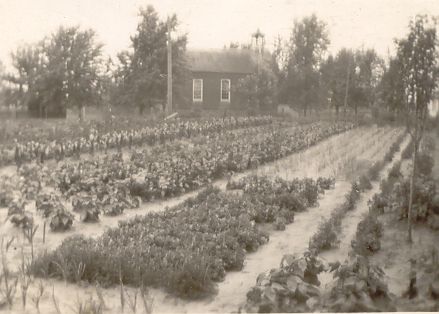
The first Richview School was a log structure built in 1838. It was located on the west side of Martingrove Road, north of Eglinton Avenue. The second school was built in 1849 on land donated by Isaac and Ann Stonehouse. It was located east of Martingrove Road. The third school was a one-room schoolhouse built in 1874. It was on the northwest corner of Eglinton Avenue and Martingrove Road on land donated by Matthew and Janet Canning. The third school was demolished and replaced in 1915 by a new two-storey building. It then closed down in 1957. The fifth and final Richview school operated from 1963-1981.
There were two cemeteries in connection with the village of Richview. The first one, the Old Second Line Cemetery also known as the Stonehouse Cemetery, is located on the east side of Martingrove Road, north of Eglinton Avenue. The second one, the Richview Cemetery, is located on land surrounded by Highway 27, Highway 401 and Eglinton Avenue.
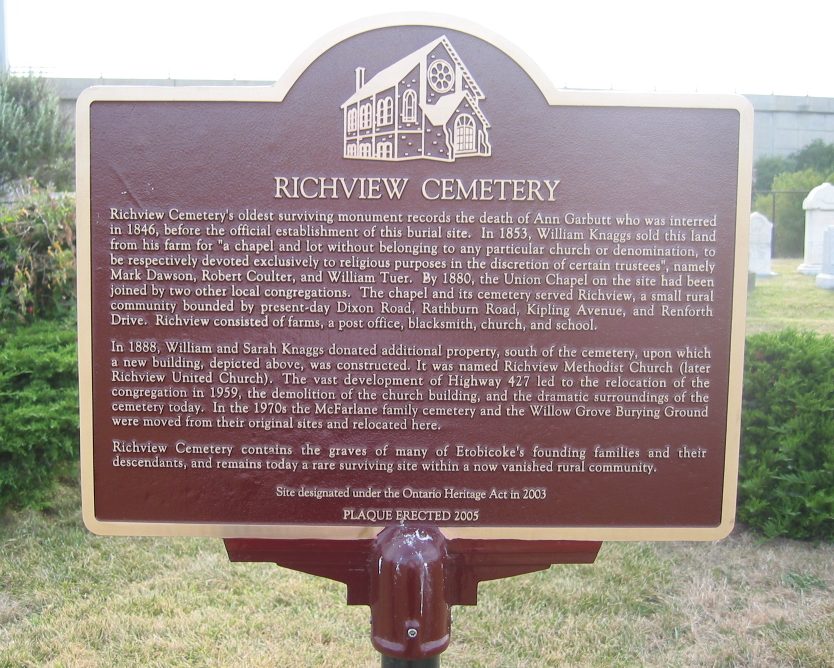
Richview Cemetery Plaque
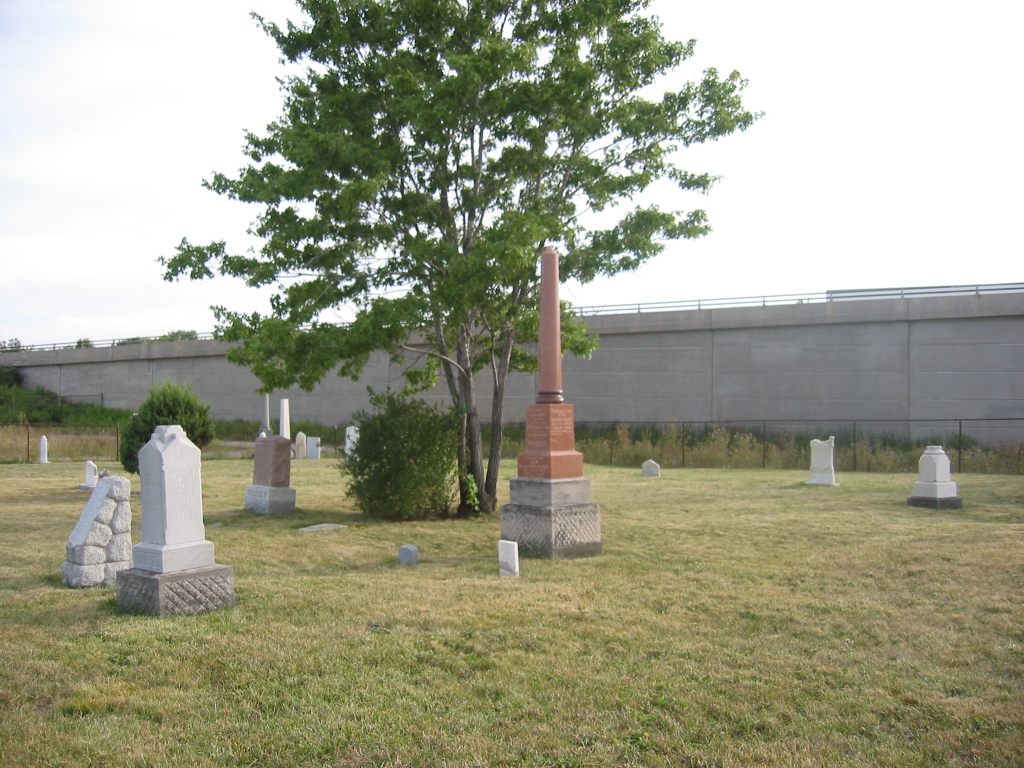
Richview Cemetery
Richview United Church was the first church in the community. Joseph Stonehouse sold the northwest corner of his farm for the church to be built on, in 1839. The church trustees for the Richview United Church were John Chambers, Mark Dawson, Robert Gracey, John Tuer, William Jolly, Robert Stonehouse, Robert Stonehouse Jr., James Stonehouse, Joseph Stonehouse and Isaac Stonehouse.
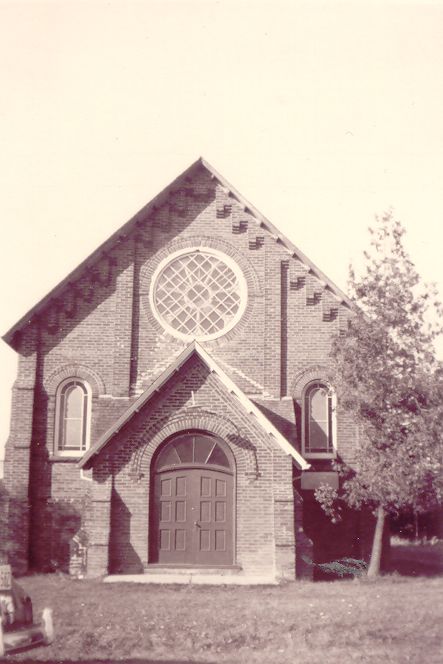
New congregations soon after developed in Richview. First, a Union Chapel was built by Mark Dawson, Robert Coulter and William Tuer, on land donated by William Knaggs in 1853. The chapel was located on the southwest corner of Highway 427 and Eglinton Avenue. In 1886, more land was purchased from Knaggs’ farm and a new red brick church was built (on the south side of Richview Cemetery), it became known as Richview Methodist Church. At different periods in time the church was part of the Etobicoke and Malton circuits. These circuits also included, at varying times, churches at Burnhamthorpe, Sharon, Bethany, Trinity (Dixie Road and Elmbank Sideroad) and Thistletown. The Church offered many activities to local residents throughout the years. In the early 1920s the Church held oyster suppers, in the 1930s there were crokinole tournaments and concerts took place at Christmas time. Sunday school picnics were held at Centre Island in the 1920s, Eldorado Park on the Credit River in the 1930s and later in Peel Park in Streetsville. The final services at Richview Methodist Church were held on February 13, 1959.
A second congregation met at the Wesleyan Methodist Chapel, built on land donated by Robert Stonehouse around 1853. The congregation was absorbed into the Union Chapel in 1868, and the building existed until 1880.
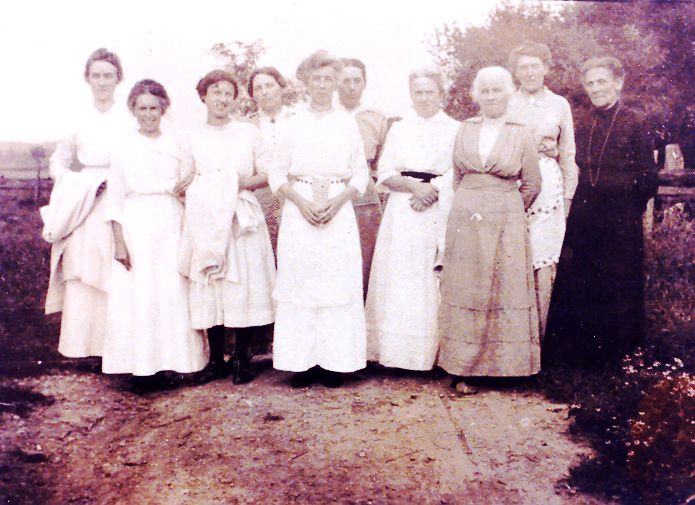
Garden parties were held at the Graceys’, on fourth line, with entertainment provided by local talent. Refreshments were also served at the Graceys’ parties, including strawberries and ice cream for dessert. Richview also had its own Women’s Institute, founded in 1914. The first meeting was held in Mrs. Ed. Stonehouse’s home and the first president was Mrs. Oliver Dixon.
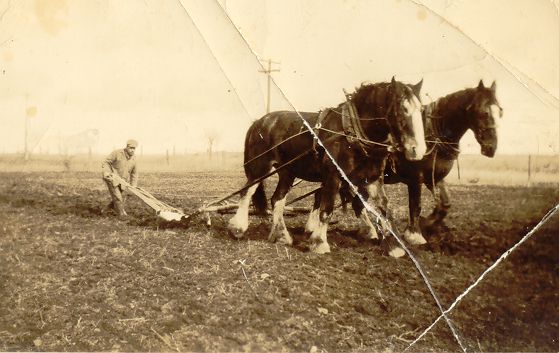
A popular sporting event in Richview was the ploughing match. The earliest record of a ploughing match is Novemeber 16, 1864 and it took place on John Davis’ farm. Apparently the date coincided with a heavy snowfall, leaving six inches of snow on the land. The residents quickly improvised and cleared plots of land for the ploughmen. Each contestant had a ¼ acre of land and four hours to complete his work.
There was a community brass band around 1875, which included members of the Knaggs and Thirkle families. William Knaggs was a noted violin maker. According to an article, published in honour of William Knaggs’ passing, in a 1921 edition of The Globe and Mail: the Knaggs were “said to be among the oldest violin makers in Canada. For more than a hundred years some of Canada’s finest fiddles have come from the Knaggs workshop”.
Louis La Rose ran a butcher shop and Christopher Thirkle ran a blacksmith shop. David Watt took over the blacksmith shop after 1890. James Peacock was the local carpenter. Thomas Whitehouse kept the tollgate on the plank road that passed through the village. Some of the main farming families at Richview were Agar, Bigham, Canning, Coulter, Dawson, Dixon, Gracey, Thirkle, Middlebrook, Peacock, Pearson and Stonehouse. During the 1920s and 1930s some of the farming families grew tomatoes for Campbell Soup Company.
According to a story told by Dr. James McKay of Malton, to William Perkins Bull, a local historian, one of his family’s goats used to make many trips to Richview. The goat would travel the two miles from Malton to Richview to a tavern located there, owned by the Davis brothers. Patrons of the tavern would give beer to the goat “for the fun of seeing him trying to wobble his way back home along the fence tops, like most men who have indulged too freely, not being able to keep his balance very long, and tumbling off to the great hilarity of the onlookers”. A different goat story tells of a neighbour’s goat that fell in through the cellar window of Richview Church. The goat was located later on “happily munching on a book”.
An additional story details the encounter of the Richview innkeeper’s wife with a wandering bear. One night while picking berries at the rear of the inn, a bear confronted the innkeeper’s wife, probably also eager for the berries. Bravely she swung her fist at the bear and hit it on the nose. At the bear’s loud howl, the woman screamed and both of them ran in opposite directions. The innkeeper arrived shortly after, having heard his wife’s cry, and shot at the bear with a gun to frighten it away. Luckily, neither the wife nor the bear were harmed.
The village of Richview was never very large, with a peak population of about 80 and a handful of buildings scattered along the border of Toronto Township and Toronto Gore. Today all that remains is the Richview Memorial Cemetery, surrounded by highways and barely accessible. Help to keep the memories alive of the families who once called Richview home, those of Burgess, Canning, Coulter, Davis, Dixon, Gracey, Knaggs, Thirkle, Middlebrook, Peacock, Pearson and Stonehouse, to name a few. Please share your memories and stories.