Brightwater Village
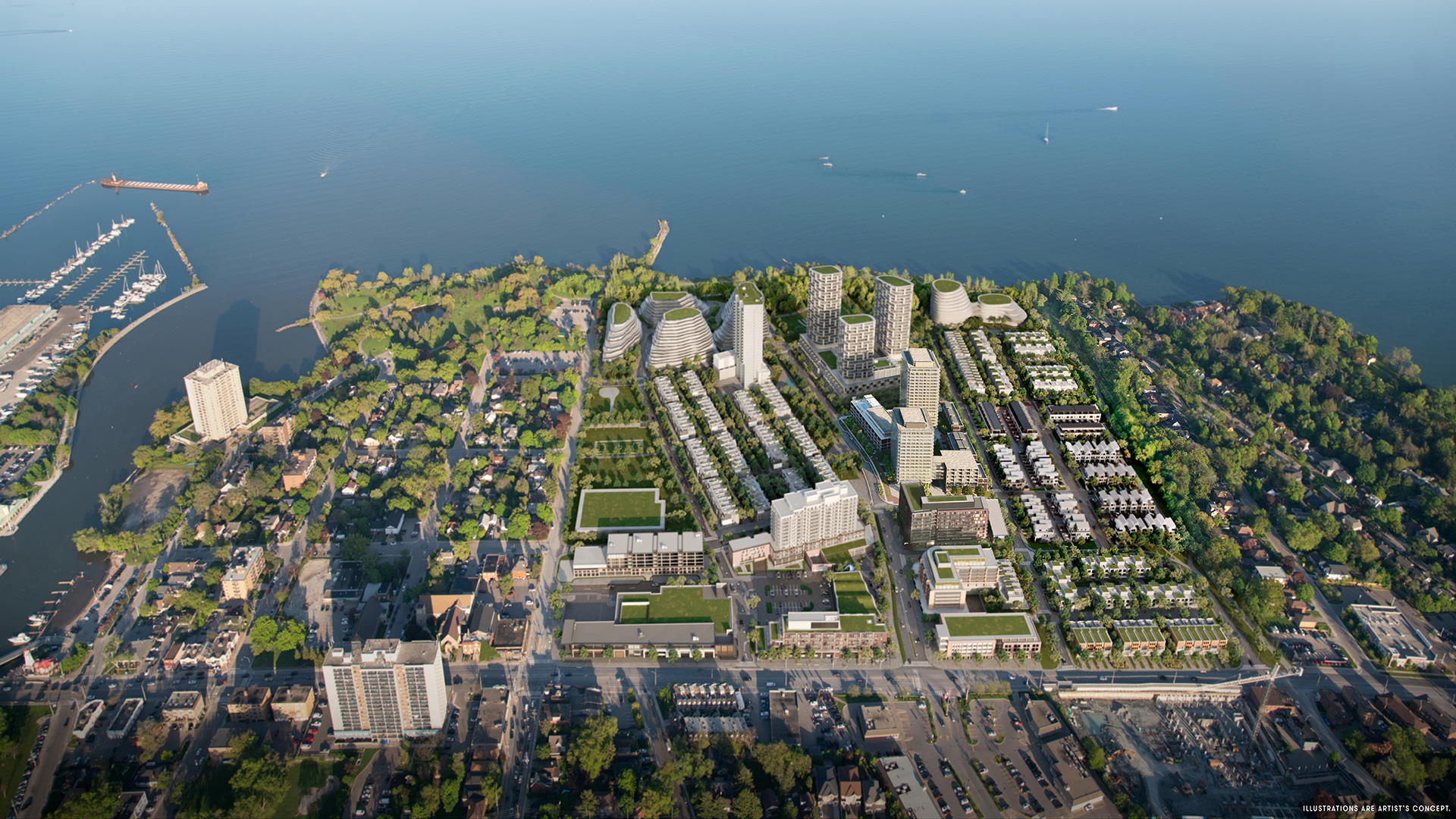
Brightwater Village is a mixed-development community located on the shores of Lake Ontario in Port Credit (a part of Mississauga). It is a large 72-acre plot of land planned for public parks, residential condominiums, townhomes, and retail space.
History
The large site once held the Port Credit Brick Company, which, while a factory, also held housing for Italian and other European immigrants that worked there. By 1929 and the development of the Toronto-Hamilton highway (now the Queen Elizabeth Way), the land was sold to build an oil refinery, but was vacant by 1988. Plans by the City of Mississauga to redevelop the area have been in the works for many years, having been formally addressed in 2012 and officially presented in 2015. A main delay for the revitalization of the land was the concern over the pollution to the soil caused by its previous industrial use. However, many developers saw it as a great opportunity to revitalize the area, especially for its rare and expansive location to the waterfront. The lot was officially sold to a development initiative called Port Credit West Village Partners, composed of Fram + Slokker, Kilmer Group, Dream Unlimited Corp, and Diamond Corp. They are an experienced mix of developers and city planners who drafted the new community.
Development Process
Brightwater was planned and developed with environmentally friendly initiatives in mind. It will have a unique mixture of medium and high density buildings: 400 townhouses and 2500 condos. Ease of access to public transit, such as the GO train, an abundance of bike lanes, and five different parks within the space are planned. However, residents will likely not even be required to travel outside of the area for their everyday needs. Also slated for Brightwater is 300,000 square feet of retail and commercial space, which give residents easy access to amenities. There are even plans to build an elementary school.
Future
Brightwater Village is still in its construction phase, having ground broken just in 2020. The developers estimate it will take 10 years to fully realize their ambitions. However, plans for opening some of the residential condominiums and townhouses will come as soon as May 2023.
Brightwater Aerial Concept
Churchill Meadows
A thriving suburban living community within Mississauga…
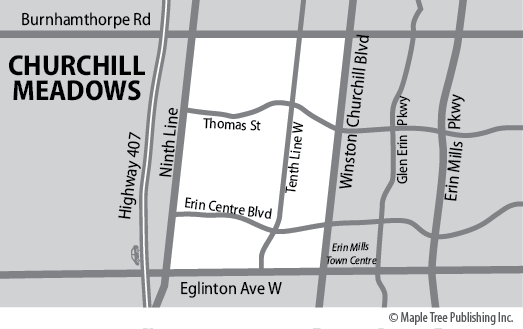
The suburban neighbourhood of Churchill Meadows was originally part of the Town of Oakville, incorporated into the newly formed City of Mississauga in 1974 by extending its westerly boundary to Ninth Line.
History
The development of Churchill Meadows began in 1987 when the City Council released the two areas for preparing secondary city plans and processing development applications for the area. At the time, the lands in the areas were mostly undeveloped, with low intensity farming throughout the district. Over the next decade, draft secondary plans were prepared, and the two areas were combined into the Churchill Meadows Planning District.
In 1997, city urban design guidelines were established for Churchill Meadows to ensure the development of a diverse mix of housing options, a connected network of parks, schools, natural features, a grid-like street pattern, and an emphasis on stormwater management. Most of the construction and development in Churchill Meadows took place between 1997 and 2001, with additional development continuing through 2010.
The planning and development of Churchill Meadows was done with a focus on creating a well-designed, sustainable community.
The Developers
The Erin Mills Development Corporation was responsible for the development of Churchill Meadows. Working in partnership with the City of Mississauga,
The EMDC played a significant role in the planning and development of Churchill Meadows. The EMDC was responsible for the acquisition of land, the creation of infrastructure and services, and the management of construction and development in the area.
Now
Today, Churchill Meadows is known for its well-planned development and attractive suburban living. The area has schools, parks, shopping centres, and community facilities. In mid to late 2017, construction began on the Churchill Meadows Community Centre, completed in 2019. This community centre serves as a hub for residents to gather, participate in programs and activities, and connect. The neighbourhood is also well connected to public transportation, with several bus routes running through the area and easy access to major highways.
Churchill Meadows Map
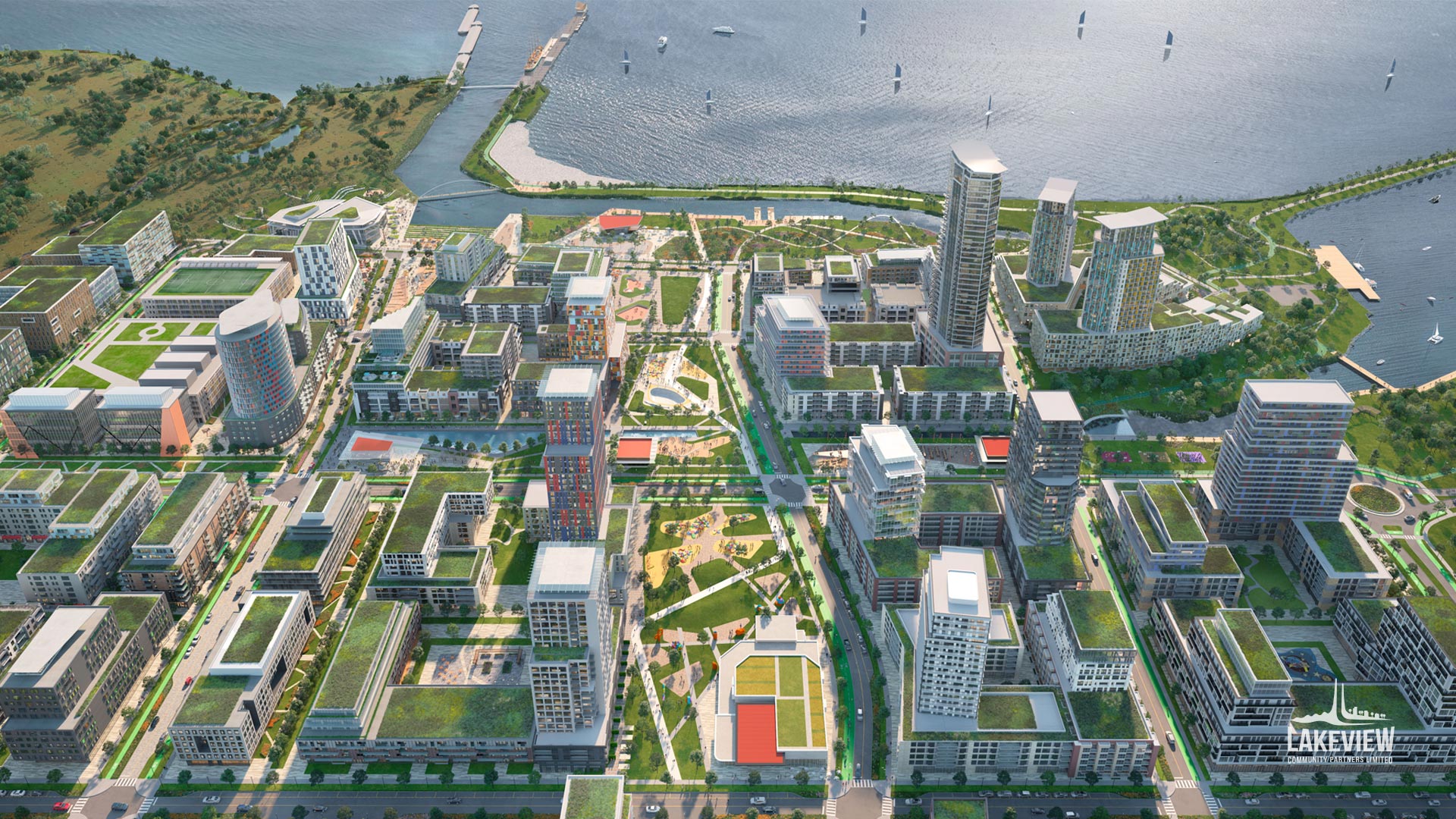
Lakeview Village
A new chapter for Mississauga’s once industrial waterfront…
Lakeview Village is a 177-acre site situated in southeast Mississauga on Lake Ontario. Its community has had a strong military and industrial presence. Now, it is being transformed into a brand new, mixed-use urban community with sustainability in mind.
From Farm to Industry
The Lakeview area was first home to the Mississauga of the Credit First Nations people, followed by European and British settlers. By the 1840s, a majority of the forested land on what is today’s Lakeshore Road had been cleared and turned into farmland. Slowly, a rural economy formed as small towns and villages began to sprout.
In the 20th century, the focus of the community shifted to national defence. Notably, Canada’s first airport and flying school, the Curtiss Aviation School, operated on the current grounds of the former Lakeview Generating Station during the First World War. Then in World War II, Small Arms Limited, a small arms manufacturing facility, was established and became a popular source of employment for women while men were deployed in the army. Today, the remnants of these developments can still be found in the neighbourhood, such as Aviation Road and the Small Arms Inspection Building located at the Dixie Road and Lakeshore Road East.
With the end of the war, the importance of wartime facilities declined, and Lakeview went from being mostly rural to a suburban setting. The coal-fired Lakeview Generating Station, also known as “the Four Sisters” by locals due to its four sky-scraping smokestacks, was built in 1958 and soon became the landmark of this area. Despite providing employment and electricity to the neighbourhood, the coal dust it produced also caused a nuisance to nearby residents. In 2005, it was retired after 43 years of service as a part of the provincial government’s effort to reduce greenhouse gas emissions.
Community Initiated
Following the demolition of the coal power plant, a gas-fired replacement was proposed. However, it was met with strong opposition, sparking discussions of putting Lakeview’s use of electricity generation behind in favour of developing a cleaner, more sustainable neighbourhood. In particular, the citizen-driven project known as “Lakeview Legacy Project” gained public traction with the vision of reuniting Mississauga with its waterfront.
Between 2010 and 2014, with unanimous support from City Council, the City’s Planning Department collaborated with Ontario Power Generation (OPG), the owner of the site and the Province, to build a shared vision for what they called “Inspiration Lakeview” that aimed to incorporate residents’ ideas. In 2018, with the completion of the Master Plan, OPG sold the property through a competitive bidding process to the Lakeview Community Partners Limited (LCPL).
The LCPL is a partnership of community builders that includes Argo Development Corporation, TACC Construction, Green Park Group, CCI Developments, and Brandhaven Homes, as well as architects from Sasaki Inc., which is known for their value of the integration of land, buildings, people, and their contexts. Not only do each of these companies have its expertise in the field of real estate development, they also share the City’s vision in building a “15-minute city” that is walkable and socially sustainable through mixed-use development and well designed public spaces.
Ideas include a pier stretching deep into Lake Ontario, new pedestrian walkways and bike lanes, a sustainable community with housing, offices and retail at its heart and an interconnected urban parks system that acts as the foundation for the Lakeview community experience, economy and lifestyle.
Starting Anew
The developers of this project have taken on a tremendous challenge transforming the site.
After purchasing the site from OPG in 2018, the developers spent over two years demolishing over 600,000 tons of underground concrete infrastructure. That concrete was transported next door to be reused in the Jim Tovey Lakeview Conservation Area, filling the lake into a new coastal conservation area. In 2020, the LCPL won the Brownie Awards for their work with the Credit Valley Conservation Authority. This coastal area has provided habitats for fish and wildlife to thrive since December 2021.
Prospect
The Master Plan for this project was endorsed in 2019 and ratified on November 8, 2021. The goal is to transform the shores of Mississauga and make this project a showcase for waterfront development.
With anticipated 20,000 residents and 8,050 residential units, Lakeview Village will also have 1.8 million square feet of employment space, creating up to 9,000 long-term jobs. The 177-acre mixed-use community project includes 64 acres of coastal wetlands, four large park networks encompassing 45 acres of green space, and 3.5 kilometers of new waterfront trail providing recreation during all seasons.
Lakeview Village is a key project in Mississauga’s continued development.