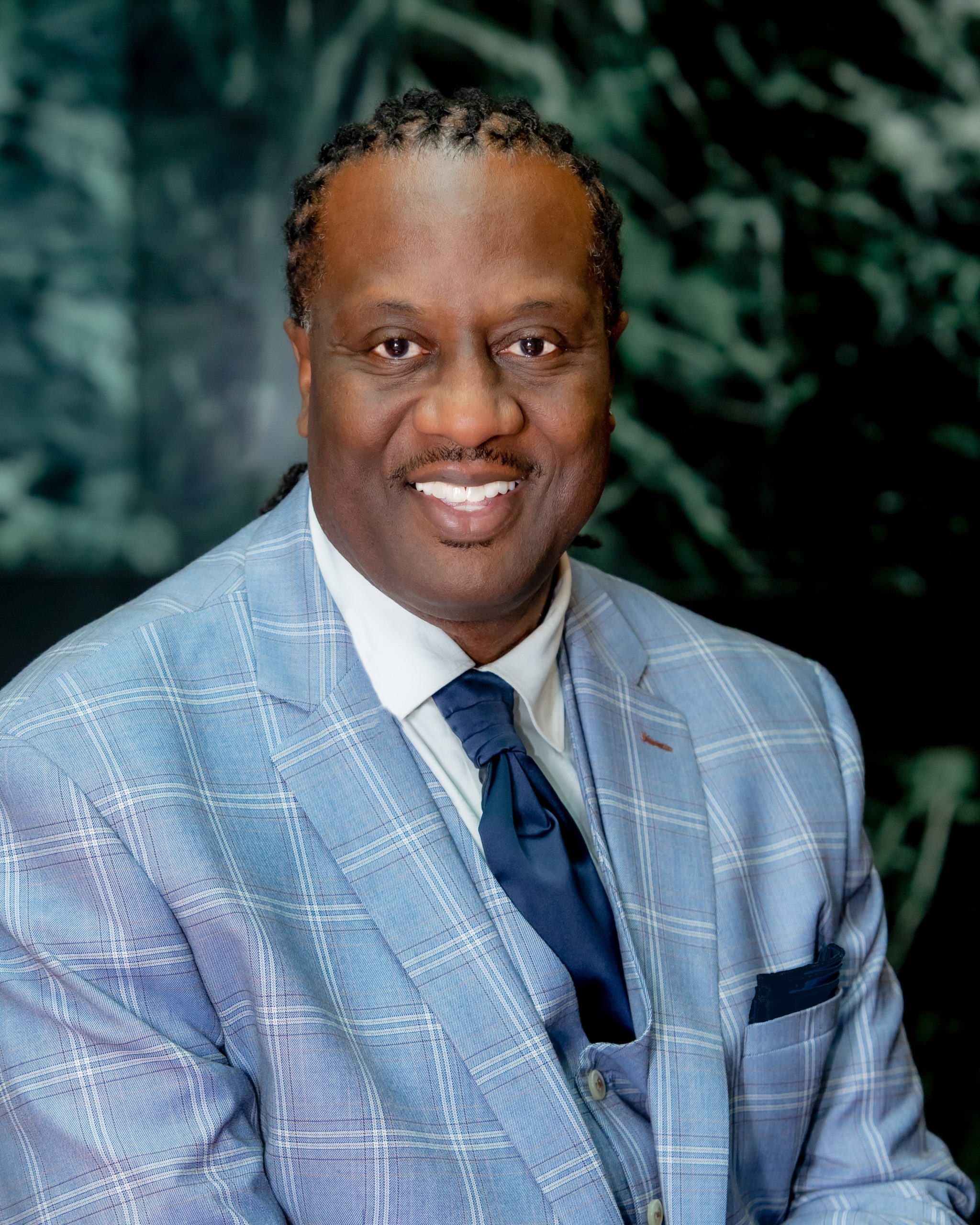
Self-love and acceptance are perhaps some of the most critical graces you can give yourself. Without this strong base, we may choose to shield our identity to protect our true selves. We clutch onto a persona- a mask we use to make us feel like we belong, but in doing so we inevitably lose a piece of ourselves. Linden King, one of Mississauga’s remarkable Black leaders, has worked tirelessly in the city to unchain our Black community from this societally imposed imposition, replacing fear with self-love. Through community support, he reminds Mississaugans that we must open ourselves up to our unique cultures to discover a sense of self in our diverse identities.
Born in Georgetown, Guyana, Linden and his family immigrated to Toronto and eventually settled in Mississauga. Throughout his childhood, Linden was brought up in a very multicultural environment. Despite assimilating into Canadian life, Linden and his family always kept a strong connection to their Caribbean roots. Christmas, for example, was one of his favourite childhood holidays at home. Looking back, Linden reminisced, “Caribbean people take that seriously. […] It’s like a whole new house you’re looking at. New bed sheets, […] and of course the traditional pepper pot.” Likewise, during Easter, Linden and his family united through their love of cooking traditional meals. In Linden culture, it’s important to look after one another during the holidays and ensure that your whole family is fed. It was a sign of their love for each other. Linden also actively assists with the Toronto Caribbean Carnival. To this day, Linden keeps these traditions alive by introducing them to his children. He is proud that they can take pride in their heritage and identity.
Linden also grew up with excellent role models. His father’s professional obligations as a Captain of the great lakes often kept him away from the family when he was young, but he vividly remembers the decision that his father made to give up his profession in exchange for a steady career path that would allow him to support his family while being able to watch them grow up. He decided to head back to post-secondary education and pursue a career in Stationary Engineering. He looked up to his dad as a strong and intelligent Black man who put his family and education first. Linden wanted to follow in his example.
His parents always encouraged him to lift up his community. Starting at a young age, Linden’s parents encouraged him to join the Boy Scouts. He particularly enjoyed the aspects of community volunteering in order to earn new badges. Somewhere along the way, volunteering became a routine embedded in Linden’s mind. Embracing this idea, Linden stated, “Volunteering was my passion. I always wanted to give back to the community.” It had opened his eyes to the many ways he could lend support to those in need.
From then on, Linden became more involved in the community. In his early life, he grew up near many local churches and valued the life lessons and morals that were preached. Many churches tend to be community orientated and rely on volunteer support. Entering adulthood, Linden was set on doing his best to uplift these churches through any ounce of support he can offer. He volunteered as a video producer and even set up many holiday stage decorations with his wife. Linden also became involved with the men’s Basketball team in his church and used this opportunity to grow long-lasting bonds with the Black community.
However, outside of his family and his tight-knit community, he soon found that following his own path was harder than it appeared. After graduating as an Industrial Instrumentation Engineering from College, Linden began searching for employment opportunities that provided a good amount of income. However, he struggled to find the right job for him. Linden temporarily worked as a packager while trying to find direction in his life. As he looked back to his experience in this job, Linden recalled a message from a colleague and mentor, West McKenzie, who encouraged him to reach for his dreams saying, “You do not belong here. […] You can do better than this.” At that very moment, Linden knew that he had the potential to keep going. After talking to his then girlfriend, now wife, she encouraged Linden to head back to school.
Before attending post-secondary school, Linden wondered if gaining an education was the best “fit” for him. He thought again and again what he should do. He could go into trades, but felt this was the path that society forges for Black men and felt he had to break this trend. Instead, he found his passion for Telecommunications Management at Toronto Metropolitan and Electrical Control Engineering at Humber College.
When attending Humber College, Linden’s professor enlightened him to a job related to his field at Toronto Hydro. After working for some time in this company, Linden was promoted to a position as a Supervisor of Telecommunications. As 10 years passed, Linden gained experience and acquired many new and unique skills. Despite Linden’s successes, however, there was always one nagging suspicion he could not ignore. It was always scattered across his brain in fragments, but suddenly, he began to perceive it as a truth. Linden noticed that despite his performance, the more novice Caucasian employees would gain higher positions in the company than himself. After all his hard work in gaining his position at Toronto Hydro, Linden still didn’t feel seen. He felt as if he were sealed and labelled into a box of underappreciation.
As a result, Linden decided to accept a position at the Oracle Corporation of Canada. Here, he felt that the cooperation recognized his skills, and he was promoted to a position as a Global Architect. After a while, Oracle Corporation encouraged Linden to relocate to Austin Texas. However, Linden and his family did not want to relocate to Southern United States. Instead, Linden decided to explore a job offer that was available at Stanford University in California. After being interviewed and offered the job. At the time, Linden’s wife was interested in heading back to school and pursuing a new career path. She needed to depend on Linden to look after their children. For Linden, two options were resting in the palm of his hands: accepting the job opportunity or giving it up for the sake of his wife’s dreams. He decided there would always be another opportunity and that, like the decision his father had made, his primary responsibility was to his family. After Linden’s wife finished school, Linden began working at Bell Canada as an Associate Director of Client Operations for over a decade.
While he was advancing in his career, Linden still found that he was facing a mountain of burdens. “I was faced with those adversities as well, trying to move up [the] corporate ladder as a Black man. […] You’re not always good enough to break that glass ceiling,” Linden stated. As a result, Linden began educating himself on the stigmas embedded in the Black community that work to rob us of our power and strength. Despite his many successes, he became convinced that there is much misrepresentation of the Black community that we as Mississaugans have yet to address fully. Linden acknowledges that a majority of companies don’t provide a diverse environment for employees. Linden stated that, “Sometimes we, as Black individuals, you look around a room and you’re not seeing people like you in that room, so…Where are we?”
As a result, society places negative connotations on aspects of Black culture they do not understand, such as natural Black hair textures and styles, which in turn is often labeled as “unprofessional”. Some employment industries expect Black employees to alter their identity and “change” their hair to fit society’s morphed image of “perfection”, while others may not even consider them.
Linden wondered if his dreadlocks were the boundary that kept him from professional advancement. Was cutting them off worth losing his connection to both himself and his culture? Struggling to fit in, Linden began to conform to others in order to feel this sense of belonging. He locked himself and his identity away for many years. He thought, “Now I have to become like my surroundings in order for me to adapt. […] Am I really being me? Am I authentic in the situation that I’m in?” After some time, Linden learned to unlearn. He released his grip from all the unrealistic expectations others held for him. Instead, he began valuing how he views himself. Linden knew that his dreadlocks did not affect his work or alter his worth as an employee or person. He is worth so much more than his appearance or how others perceive him to be. Linden decided to choose, day by day, to carry an optimistic mindset and embrace every aspect of himself regardless of what people thought of him. Recalling this idea, Linden stated, “When you wake up in the morning and you look in the mirror, you’re seeing a Black man. You have to tell yourself ‘I love myself’ for one, and also, two, ‘I have to strive twice as hard to be equivalent to other individuals that are out there.’” He pushed himself to become a self-reliant leader who embraced his own self-love. Eventually, Linden became a Senior Manager IT Operations for the Peel District School Board.
Linden was soon praised for his hard work and was even told that he was the first Black man, in 25 years, to be carrying a senior level position in IT. Linden thought to himself, “I’m the first Black, but guess what, I’m not gonna be the last.” Despite this, Linden was still worried if all his efforts would be enough. He wanted to set an example for his community, yet the barrels of expectations were towering over his shoulders. Not only was he worried about failing himself but also the countless future Black leaders who depend on him to create a mark in the Black community. Deciding to work hard in this position, Linden believed, “that stereotype that they have of us is not going to be reflected on me in this role.”
In this capacity, he began to think seriously about the role of young people in shaping our future to allow opportunities, such as employment, to be equitable for all. To begin this road towards change, Linden believes that Black youth must exercise their voting rights. Linden acknowledged that “there’s a number of people who died for us, to walk in and put an x on that ballot.” He feels that we must not let those who have fought so valiantly for us die in vain. They sacrificed everything so that Black youth could openly and freely express their powerful voices for peace and love.
Over 50 years after his arrival in Canada, Linden is dedicating himself to these same goals here in his home of Mississauga. Linden has been recognized by the City numerous times for his contributions to the Black community through his work as Chair of Mayor Crombie’s Black Caucus, Chair of the United Way Greater Toronto Black Community Advisory Council and a director for the Mississauga Arts Council and the Canadian Mental Health Association.
Throughout everything, his family has always been there to give him strength. His wife and children have helped shape him into the leader he is today. They are his source of inspiration to fight for justice and equity. He graciously thanks his wife for her contributions to his life saying, “Once you have that soulmate that can work with you and […] understand you and support you in what it is you’re doing, that makes your life a lot easier.”
A word from the wise: Linden knows the merit heritage has in understanding our “roots”. He believes that, “Once you understand your history, once you also identify as to who you are, you will be able to move forward.” For Linden, this has meant celebrating his Caribbean culture, but for each person it is different. Sometimes, these bits of self-love are small, but to move forward, you have to learn to appreciate them. For Linden, he sees them hidden in family meals, running through his dreadlocks, and packed into the pews at his church. Love, Pride, and Community. They all work their way into becoming the vision of an authentic community leader, like Linden King.